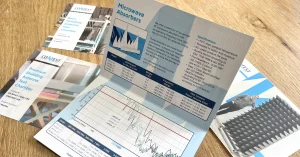
Absorberhype at EuMW 2026
Exhibiting alongside our UK representatives, Melcom Electronics Limited, was a great success. ‘I almost ran out of my Microwave Absorber postcards!’ said Vincent van de Vrie, our on-site Technical Consultant.



Exhibiting alongside our UK representatives, Melcom Electronics Limited, was a great success. ‘I almost ran out of my Microwave Absorber postcards!’ said Vincent van de Vrie, our on-site Technical Consultant.

With the 29th European Microwave Week (EuMW 2026) coming up next week, we celebrate our first anniversary of working with the great team at Melcom Electronics Limited. At last year’s EuMW, they became our exclusive distribution channel for the UK and Ireland within our international reseller network.
This chamber, which we built for testing Envirotainer’s containers to protect medicines, is larger than you might think. “The team from Envirotainer, a global leader in temperature-controlled logistics for biopharmaceuticals, approached us in 2022 to build a new ferrite chamber to test these containers for shipping by air, which requires DO-160 compliance,” explains Uliana Trucchi, our Technical Consultant for this project.
Uliana: “I advised making the chamber future-proof and preparing it for the CISPR-16-1-4 and IEC61000-4-3 standards, to enable these containers to comply with the norms of different environments, such as hospitals, etc.”
Linda Wiman, Director of Compliance Verification & Documentation at Envirotainer, worked closely with Uliana on this project and appreciates her proactive advice. Linda: “It’s more efficient to do the extra preparations for CISPR and IEC at once rather than realise we need the Comtest team to return later for an upgrade. In this case, it meant extending the absorber lining, and the Comtest team needed a bit more time to validate the chamber for the additional standards. But thanks to Uliana’s advice, this chamber is prepared for the future, which makes my life easier.”
The chamber is 3.225 m high (which is standard), but it’s 9,150 m long and 6 m wide. The door measures 2.4 x 2.4 m in total. Overall, it’s an excellent example of designing a customised solution together with our client.
Are you an OEM and not fully aware of the alternative standards that may apply to your products in the future, given the rapidly changing world? Do not hesitate to ask one of our Technical Consultants for advice via the contact page on the Comtest Engineering website.